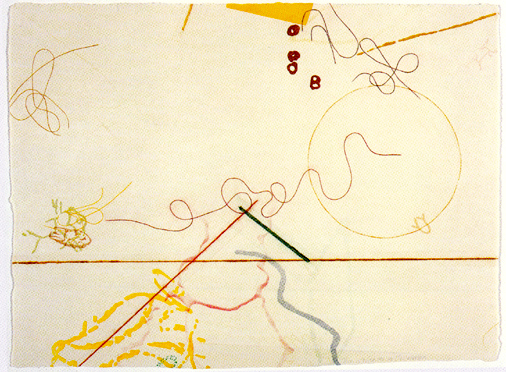
 number 23 from 'Déreau' (1982), by John Cage. A series of 38 engravings with drypoint, aquatint, and photoetching determined by the i ching.
Basics
Course: Digital Studio Semester: Fall 2026 Meeting Times: Tuesday & Thursday Location: Little 113, Bernstein 103
Contact & Connections
Instructor: Margaretha Haughwout, any pronouns Email: mhaughwout@colgate.edu Office Hours: [times and location] Course Discord/Slack: [link]
Course Description
An introduction to digital art that covers select topics from a variety of digital art practices rooted in indeterminacy, algorithms, and speculative practice, and which in turn produce 3D printed objects, dynamic digital sketches made in p5.js, and textiles produced on the digital loom. Magical practice is a thematic underpinning driving an ongoing set of questions around its similarities and differences to technology, and these questions inform our creative output. Furthermore, as a result of iteration, remixing, and collaboration, we come to see art more as a process than a thing, more dynamic than static. Students are encouraged to explore concepts and programs beyond the basics; group and individual projects will require both rigorous concept development and proficiency in technology. The Little Hall Digital Studio, and the Fab Lab in Bernstein Hall are equipped with relevant hardware and software.
Guiding Questions and Course Objectives
Add your course objectives here.
Course Materials
Add your course materials here.
Resources
Add your resources here.
Assignment Grade Breakdown
A1..........25% A2...........25% A3...........25% Sketchbooks and Exercises..........10% Participation..........15%
Grade Rubric
Conceptual-- Technical-- Perceptual qualities/ aesthetics-- A -- Excellent. Student exhibits exemplary conceptual, technical and perceptual ability implementing projects. Planning, thoughtfulness and patience. Brimming with ideas. Student is connecting readings, discussions and course concepts to their work. Ability to successfully communicate ideas andprocesses to others. All work is lucid and engaging. B -- Good. Student completes assignments, and demonstrates a grasp of most of the main aspects of each lesson, but not all. Some planning and thoughtfulness. Is able to communicate information, and step by step processes well. In projects, conceptual, perceptual, and technical skills are present. C -- Satisfactory. Student completes the assignment but may lack enthusiasm or drive to push the work into a detailed perceptual, technical, and conceptual space. Student does not consistently demonstrate patience, enthusiasm or planning. The work is underdeveloped. D -- Unsatisfactory
Requirements, Policies, Thoughts on Being Present
Add your requirements here.
Learning and Support
We all learn in our own ways. While many different kinds of engagement with the course material are required, some of us will move through this class more conceptually, some more perceptually, others more technically, still others more rationally. Some will process the material in solitary ways, while others may be quite vocal. I expect to see visual, auditory, and linear learners. Please talk to me as soon as you can about the ways I can support your learning modes. If you do not have a documented disability, but feel you need some help, do remember that the Center for Learning, Teaching and Research is available to you ( center-for-learning-teaching-and-research). Your success in this class is VERY important to me.
Events
Adam S Goldman visit, other guest artists